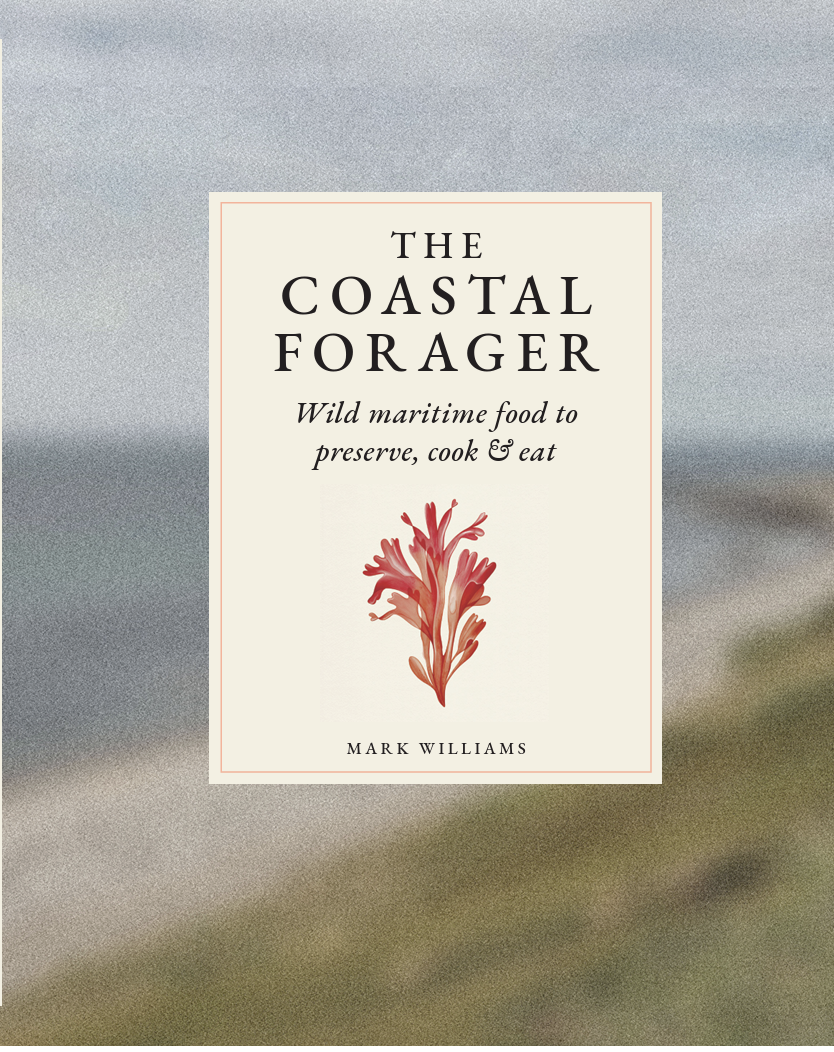
Description
“The book we have all been waiting for!”
“…honestly the most beautiful book on wild food – or food actually – I’ve ever seen.”
– Liz Knight, author of ‘Forage’, ‘Buds and Blossoms’ and ‘Wild Drinks’.
A 272 page guide to the edible opportunities of North Atlantic coastlines; covering coastal plants, seaweed, shellfish and more, from professional foraging guide and wild-food chef Mark Williams.
“The Coastal Forager is a sumptuous celebration of the wild foods found in abundance on our shores. Mark’s deep knowledge and love of these plants and seaweeds is distilled into a beautiful, authoritative guide, illustrated with both detailed botanical illustrations and useful photographs of everything in situ. The text reflects his quiet mastery of the subject with humour and an obvious passion for foraging. And, I can assure you – having tasted them over the years – that each recipe is a gourmet’s delight.”
– Mo Wilde, author of ‘The Wilderness Cure’ and ‘Wild Food’
If you’ve enjoyed the information on this website and fancy owning a beautifully illustrated and photographed even deeper dive into coastal foraging, this is the book for you! Learn more about the author here, or scroll down to read a review.
Cover Price: £28.00
Order a signed copy at cover price direct from the author, with free UK postage.
I hugely appreciate direct orders, as I make more than my standard (tiny!) commission on books I sell directly. Its the best way to support my work and free content. You can request personalised messages/dedications during checkout, by using the “Order notes” section.
Price is for UK deliveries only, sent by 48h Tracked Royal Mail. I aim to have UK orders with you within 4 days.
For gifting, you can specify a delivery address that is not your own at checkout.
You can also request dedications, personal messages etc for me to write in the book, and/or request a separate seaweed notecard to be packaged with the book – please specify exactly what you want me to write in the book or on the card in the “notes” section at checkout. If you don’t request anything, I will just write “Happy Foraging” and sign it.
Delivery Outside the UK
If you would like to order a signed copy direct from the author for delivery outside the UK, order above and i’ll get back to you by email to sort out the extra postage cost. (Delivery time: Allow 3-5 days for most of Europe, 6-7 days for rest of world). Indicative prices for extra postage of 1 book to common destinations below (ordering multiple copies will cost less per book in extra postage). Non-UK prices do not include customs fees, which may be required in the destination country and are the responsibility of the receiver to pay on delivery. If you wish to cancel your overseas order when I contact you about about extra postage costs I will refund you the full amount less Paypal fees of £1.11)
Ireland +£7.00 GBP
France, Germany, Netherlands, Denmark +£8.00 GBP
Norway, Sweden +£12.00 GBP
USA +£17.50 GBP
Canada +£18.50
Alternatively the book is available in all good book stores now, or from online retailers including:
Bookshop.org – Recommended – a great way to order online AND support real world local book shops.
Waterstones – Ordering here will mean they distribute more copies to their real-world book shops.
Barnes and Noble (US) – For US and Canada online orders – copies will be shipped directly from the US.
Amazon – Please leave a review if you can! They really help!
To the knowing eye, our coasts are an incredible source of nutrition and flavours – from aromatic maritime herbs and succulent coastal vegetables to umami-rich seaweeds and gourmet shellfish. Join Mark on an intimate gastronomic and ecological journey through a dazzling range of coastal habitats, learning how to safely identify, considerately harvest and creatively cook coastal wild foods.

The book is broken down into coastal habitats, with deep ecological and ethnobotanical explorations of each niche
The coast is not just one habitat, but a complex tapestry of ecosystems, woven by the sea. Structured around these distinct habitats – salt marsh, shingle, cliffs, sandy beach and the intertidal zone – the book leads us on a detailed exploration of an incredible and diverse range of edible species, with fascinating insights into their ecological roles and ethnobotanical history. Featuring a mix of stunning illustrations from Sofia Iva and informative and evocative photographs, we learn how to safely, legally, considerately and deliciously connect with them. Through recipes, seasonal tips, preserving guides, and fascinating personal stories from Mark’s own wild and rugged coastal home in Scotland, you will discover the flavours, nourishing abundance and fascinating stories of our North Atlantic shorelines.

Detailed explorations of safe, legal, responsible and considerate foraging, with all a beginner needs to know and lots more
“Foraging is so much more than just finding food. It is about finding our wild and free selves and The Coastal Forager is a giant leap in that direction and sure to become an instant classic. Mark’s enthusiasm and years of experience foraging on the coast is clear, and between these beautiful presented pages he treats us to his wealth of knowledge. As one of the world’s leading authorities on the subject we are in good hands. And for those who have followed him online and read his blog, you will not be disappointed. He continues to write with honesty and humour and as ever, I remain in awe at his ability to convey information in a straightforward, non-patronising manner.
I can hardly see a group of people who won’t benefit from this book: from parents bored of digging sandcastles and in need of coastally inspired cocktails, to barbeque hosts looking to wow their hot dog munching friends (rosehip ketchup anyone?), plant lovers and botanists interested in expanding their repertoire, to those interested in gut health.’
– Andy Hamilton, Author of Booze For Free, New Wild Order and The First Time Forager.
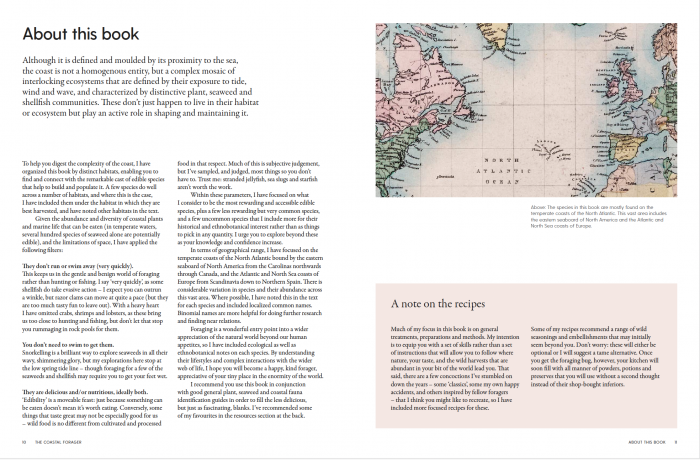
The book covers the European and North American coasts of the North Atlantic
“The Coastal Forager cleverly presents the coast not as one place, but as a sequence of habitats and thresholds, each with its own edible life and ecology. Salt marsh and estuary, shingle, cliffs, sandy beach, the intertidal zone, even maritime woods and hedgerows, the effect is to make the coastline feel less like a backdrop and more like a richly structured layered world of quite different habitats.
That is part of what makes the book so strong. It is not just a field guide. It is ecological and ethnobotanical as well as culinary, with recipes, preserving, cooking tips, seasonal guidance, and a strong sense throughout of place, identification, and responsible harvesting. I especially like that broader approach and the creativity of the recipes. It does not simply tell you what can be eaten. It shows how wild maritime food can be understood, gathered, preserved, cooked and enjoyed.”– Natalia Joanna, Foraging Guide, FB Review

Includes over 120 pages on 35 coastal plants and herbs, with detailed botanical illustrations, “at-a-glance” notes on distribution, similar species, season etc
“This book is one of the best I have read on foraging (…and I have read quite a few!). It has introduced me to loads of new sea plants / seaweeds, and also has some really good recipes in it. Because it is set out into zones where you can find things, it makes it much more practical as a field guide. Looking forward to exploring the coastline and trying new tastes!”
– Anderson Hirst, Amazon Review
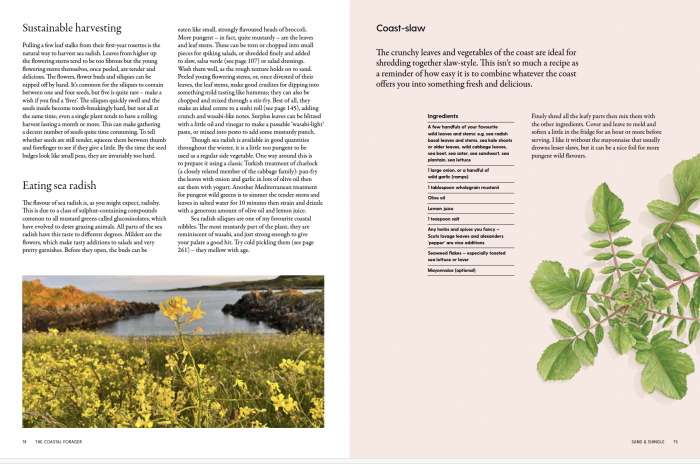
Detailed text explores the ecological role, ethnobotanical history, sustainable harvesting strategies, recipes and eating/preservation suggestions of individual species, accompanied by detailed full-colour photography
“We joined one of the authors excellent one day foraging courses and had always meant to book another but life got in the way. Bought this book as soon as I saw he had written one and was not disappointed – all of his knowledge and passion for the subject are apparent. Very well researched book with excellent combination of illustrations and photographs, recipe suggestions and tips. Highly recommended if you want to improve your foraging skills.”
– C-Mal, Amazon Review
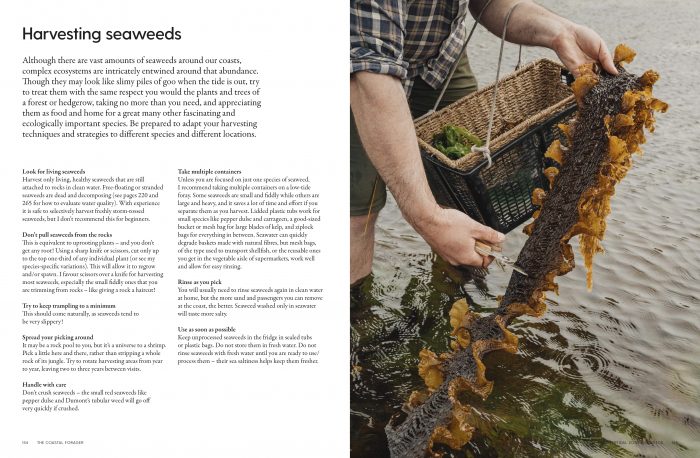
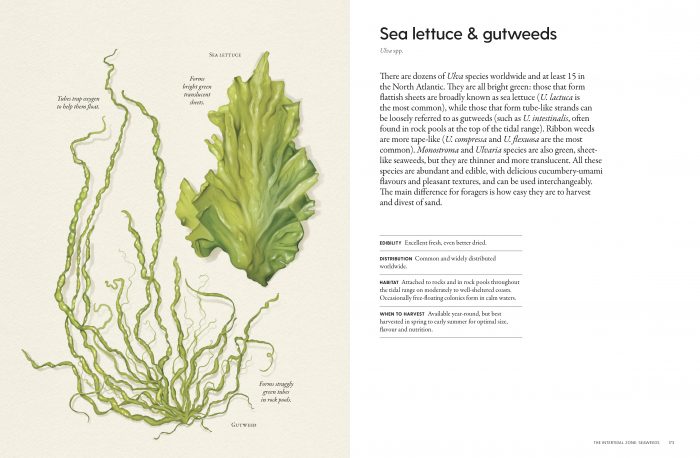
Includes over 70 pages on seaweeds, including their food uses and medicinal properties and deep dives into 20 of the most rewarding species, with recipes, considerate harvesting strategies and ecological information
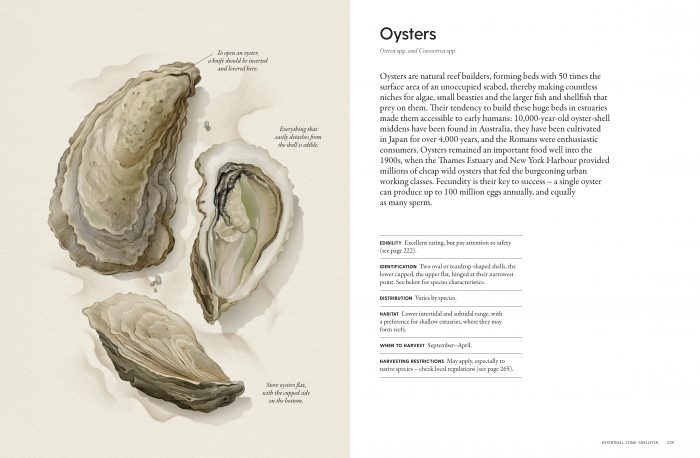
Includes 37 pages on the most accessible shellfish for foragers, with detailed information on safe harvesting, avoiding pollution, depuration, recipes and preservation
Book Review – The Coastal Forager
Reforesting Scotland, Issue 74, September 2026
.
This book is a box of delights! Beautifully designed and produced, it is a pleasure to handle. It opens to reveal choice photographs on a grand scale by Charles Emerson, interspersed with pleasing and informative botanical drawings by Sofia Iva, all printed on fine paper that feels good to the touch.
But it’s not just a pretty face. Mark Williams is one of Scotland’s most well‐known and experienced foragers. He speaks with real authority, backed with scientific references, and clearly makes it his business to understand the chemical composition of plants. This is important when you are dealing with potentially toxic species. Yet this is done with such grace that it is a compelling read.
Mark’s enthusiasm for his foraging life and for certain plants in particular spills through every paragraph, like “the earliest, biggest, juiciest and sweetest fruits tend to swell near our coasts, and also some delightful aromatic herbs, the stems and leaves of which grow faster than their inland kin”.
Very clearly organised by coastal habitat, the book is easy to use. It covers shore plants from all of them: coastal scrub, sand and shingle, cliffs and crags, salt marsh and estuary, as well as seaweeds from all the intertidal zones, and shellfish. Mark is full of very sensible advice about safety and easy harvesting and always has an eye on respectful and sustainable gathering. He doesn’t want his readers to fall off a cliff when gathering rock samphire (as many people have in the past) or to eat too much of these, or any other, plants that are only locally profuse.
Added to all this are the excellent recipes, for as well as explaining in general how to handle different species, Mark includes descriptions of dishes that have to be tried. Take his ‘Sea beet and smoked haddock tart’, for example, or his ‘Wild coastal broth’. It all makes me yearn for the seaside and a nice clean, quiet shore to get foraging in order to cook such delicious‐sounding things!
Don’t ruin this handsome book by shoving it in your rucksack, but read it at home to savour its pleasures and get to know what to look for. It should go on rewarding you for years.
Fi Martynoga