Psychology, Mycology, and the Anti-Foraging Paradox
The first in a series of guest blogs on the politics and psychology around fungi foraging in the UK, by Natalia Banach. These posts are adapted from Natalia’s excellent Facebook posts – follow her here here.
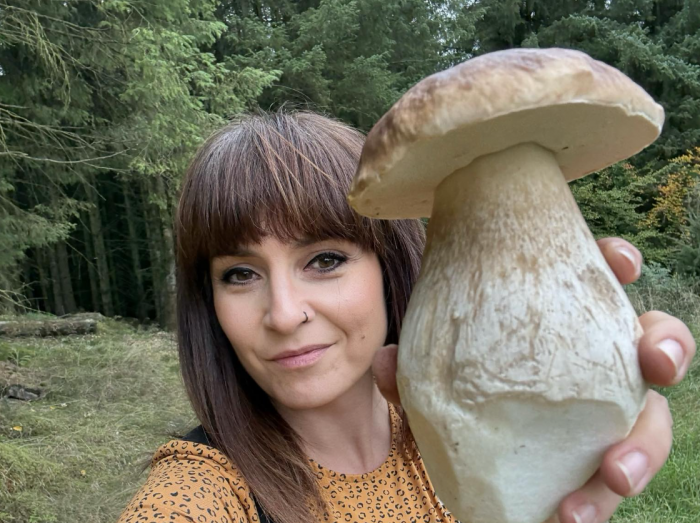
Natalia is a Polish-born psychologist, clinical researcher and mushroom forager based in the Shropshire Hills. Her research in psychology has appeared in peer-reviewed journals. Outside work she studies and writes about ethnomycology, exploring how people and fungi shape each other’s cultures and habits. She collects mushroom recipes from around the world and spends much of her free time in the woods with her dog, looking for interesting mushrooms.
Psychology, Mycology, and the Anti-Foraging Paradox
I spent the first half of my life (twenty years) in Poland. Polish mushroom culture means families in the forest, kids with baskets, grandparents arguing over boletes, whole weekends built around mushrooms. I’ve foraged in Poland, Italy, France, places where people have been filling baskets for centuries– and the woods are still heaving with fungi. Foraging there is ordinary, joyful, almost unremarkable.
.
I’ve spent the next twenty-odd years in the UK: one of the most nature-depleted countries in Europe, where recreational foraging is tiny, and yet a small group of British mycophiles will confidently tell foragers that they are the ecological problem.
When your lived experience, your culture and the available science all lean one way – and a handful of people insist, with great confidence, on the opposite – it stops feeling like “caution” and starts to feel a lot like gaslighting. As a psychologist and a mycophile, I find it oddly offensive, and I also really want to understand it.
.
I’m not talking about the average person who thinks “toadstools are poisonous” and vaguely disapproves of mushroom picking. I mean a tiny, but noisy and influential subculture – realistically maybe twenty or thirty people – who like fungi, know some mycology, can ID a mushroom… and are fiercely, permanently anti-foraging.
.
And just to be clear what I mean by “foraging” here: I’m talking about ordinary, respectful, personal-level mushroom picking, the sort of thing I do now, and the sort of thing my grandparents and great-grandparents did, and people in my part of the world have done for centuries. I’m not talking about industrial-scale commercial harvesting or raking whole hillsides bare.
Over time I’ve noticed a few consistent features of this group:
- It’s never the top people in the field taking their hard, blanket anti-foraging line. In all the papers and books I’ve read, I’m not aware of a single leading mycologist whose evidence-based position is that normal, respectful foraging is ecologically damaging.
- The evidence they lean on doesn’t actually say what they say
- And everyone I ever see making this argument in the field also collects mushrooms themselves
Once you see that, you can’t unsee it, and the psychology starts to shout loudly.
1. What the science around mushroom foraging actually says (and the Białowieża paradox)
If you push the social-media noise to one side and look at what’s been done in real forests, the picture is fairly clear.
Long-term studies in European woods – most famously the Swiss experiments by Simon Egli and colleagues, tracking permanent plots over decades – have compared areas where mushrooms were picked, areas where they were cut, and areas where they were left alone (Egli et al. 2006 and follow-up work). They did not find that harvesting fruit bodies reduced future yields or species richness. What did matter was trampling and general habitat damage, not the moment the cap is removed.
Conservation work, across multiple countries, keeps pointing at the same main drivers of fungal decline:
- habitat loss and fragmentation
- forestry practices and short-rotation plantations
- pollution and nitrogen deposition
- drainage, climate change, and general ecological battering
– not “someone took home a basket of chanterelles”.
.
And then you have what I’d call the Białowieża paradox.
.
Białowieża, on the Polish–Belarusian border, is widely regarded as one of Europe’s richest fungal hotspots, with thousands of species recorded and many more expected. It sits in a country where mushroom picking is practically a national sport, and has been for centuries. Heavy, normal, everyday foraging – and yet off-the-scale fungal diversity.
.
So the two things this little anti-foraging subculture wants to bolt together – “people pick mushrooms” and “fungi decline” – simply don’t line up cleanly once you zoom out. The mycologists actually working on conservation talk about habitats, pollution, climate and forestry. You can go a long way down the list of the world’s most cited fungal ecologists without bumping into a hard, anti-foraging stance.
.
That’s already awkward. And it sets the stage for the next problem.
2. The core contradiction in anti-foraging behaviour
Given that backdrop, their day-to-day behaviour becomes hard to square with their rhetoric.
The pattern is almost always the same:
- Foraging for food = bad, selfish, damaging
- Picking the same species “for science” = noble, necessary, virtuous
The same people who condemn foragers will happily fill baskets to ID, spore-print and put specimens under the microscope… then dump the lot. From the fungus’s point of view, those two behaviours are functionally identical. Once you’ve removed or destroyed the fruitbody, the main ecological event has already happened: that structure is no longer out there, attached to the mycelium, dispersing spores into the forest in the way it was.
Whether the mushroom then ends up on a herbarium sheet, in a compost heap, or in someone’s risotto doesn’t change what the mycelium experiences. So if your claim is that removing fruitbodies is ecologically harmful, then your own collecting is just as “harmful” as a forager’s. The only thing that changes is what a human does in the last two minutes of the story.
That isn’t an ecological line. It’s a taste / purity line about what other people are allowed to enjoy.
From my cultural background, there’s another twist: deliberately collecting a basket of edible mushrooms and then throwing them away isn’t “ethical”, it’s offensive. To the forest, to the food, and to the cultures where that knowledge is part of how you live. Being told that behaviour is virtuous while eating what you pick is “selfish” is… well, it’s quite something.
3. The psychology of anti-foraging stances
Once you put a psychology lens on this little subculture, the stance stops being mysterious and starts looking very human.
.
Purity / contamination
In moral psychology there’s a “purity” dimension – the sense that some things are sacred and shouldn’t be “contaminated”. You can see that at work here. The same chanterelle on a slide feels like clean, ascetic “science”; the same chanterelle in a frying pan feels like a defilement. Ecologically it’s one fruitbody removed either way. Psychologically, one is pure, the other is contamination.
.
Cognitive dissonance
Inside the head, the story is something like:
“I see myself as a protector of fungi… but I also pick loads of fungi.”
That’s uncomfortable. To resolve it, you invent a rule that saves your self-image:
“Picking to eat = harmful.
Picking for science = noble.”
It isn’t an ecological rule; it’s a narrative patch that allows your behaviour and your identity to coexist. Add in the awkward fact that none of the senior people in your own field are loudly backing you, and the dissonance only increases – so the rule has to be defended even harder.
.
Identity and status
There’s a lot of identity tied up in being “the guardian of fungi”. If your role in a tiny community of 20–30 like-minded people is gatekeeper, ordinary foragers can feel like a threat – they dilute your specialness. Admitting that careful foraging is basically fine doesn’t just tweak an opinion, it undermines that role. At that point you’re not really defending data; you’re defending a position in a very small tribe.
.
Cultural mycophobia
In my world, kids and grandparents in the forest with baskets are normal. In Britain, fungi still sit in that uncanny space of “weird, dangerous, better not”. That old mycophobia doesn’t vanish when someone learns the Latin names; it often just gets expressed in more elaborate language.
.
Put all of that together and you get a stance that feels moral and scientific from the inside, but doesn’t line up terribly well with what the mycelium (or the evidence) is actually doing.
.
Anti-foraging stances are a moral preference, a particular mix of purity, dissonance, status and mycophobia, wrapped in the language of conservation.
4. An open invitation
Because I do actually care about the evidence, I’d be very happy to debate this with anyone in that tiny anti-foraging subculture who is a mycologist and genuinely believes normal foraging is ecologically harmful. If you’d like to engage constructively, please comment below. Comments are moderated, so there will be no pile-ons, no cheerleaders, just a calm, public conversation about data, logic and lived experience. It would be respectful and focused, and you can take all the space you need to make your case.
2 Comments
I love this very clearly expressed and ( to my mind) totally convincing argument. I have picked Lactarius Deliciosa in French forests where the mushrooms are still widely available and some of the best I have tasted. Isn’t the name an indication of the beauty of their edibility?
I so appreciate your thoughtful input on this! I have heard/experienced similar anti-foraging arguments here myself (Idaho, United States). Like you, I’ve found that the loudest voices saying “we have to protect the fungi” and “there’s not ‘enough’ available…if everyone started foraging today, we would strip the earth bare” are quite often the very same people who I know for certain are harvesting large quantities of edible mushrooms for themselves. It’s as if they assume no one else can “do foraging right”; it seems a bit hypocritical and selfish.
Beyond that, the possibility that 100% of people would ever be foraging at the same time is vanishingly small. And in my opinion, the more people we can educate and encourage to ethically forage, the better it will be for our local environment, ecology, and food security! The places my family has foraged for decades continue to produce abundantly and generously. (And, in Idaho, there are literally millions of acres beyond what we can reach that remain relatively untouched, where the plants and fungi live out their life cycle without human intervention.) The only areas where this seasonal cycle has been interrupted and we can no longer harvest have been areas destroyed/disturbed by either clear-cut logging (everything is taken and sometimes herbicides applied after) or injudicious land development. Even the forests burned by huge wildfires can often recover within 2-3 decades, depending on severity. So I tend to agree: it’s not normal, informed foragers causing damage. They have a vested interest in caring for the places from which they collect food.