Poisonous plants – hemlock
Conium maculatum
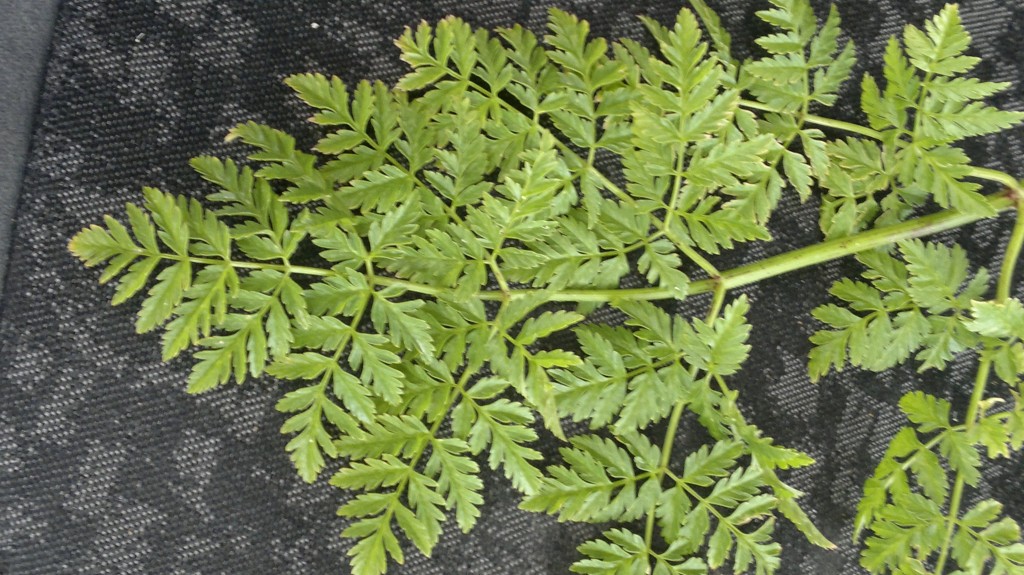
Hemlock leaf structure
Hemlock is not the common species it once was, especially in farming areas like Galloway. It is as toxic to livestock as it is to humans, so farmers have all but eliminated it from inland areas. It is most commonly found coastally, having a preference for sandy soils, but that’s not to say it doesn’t lurk inland too. It is more common in E Scotland and S England.
It grows up to 2m tall, and has more delicate looking (fern-like) leaves and white flower umbels than many of its carrot family relatives. Cow parsely has very similar leaf structure . The key diagnostic of poison hemlock is its hairless, cylindrical, red spotted flowering stems. It also has an unpleasant mousy smell.
For a full rundown on how to distinguish poison hemlock from cow parsley, please see my post on cow parlsley.
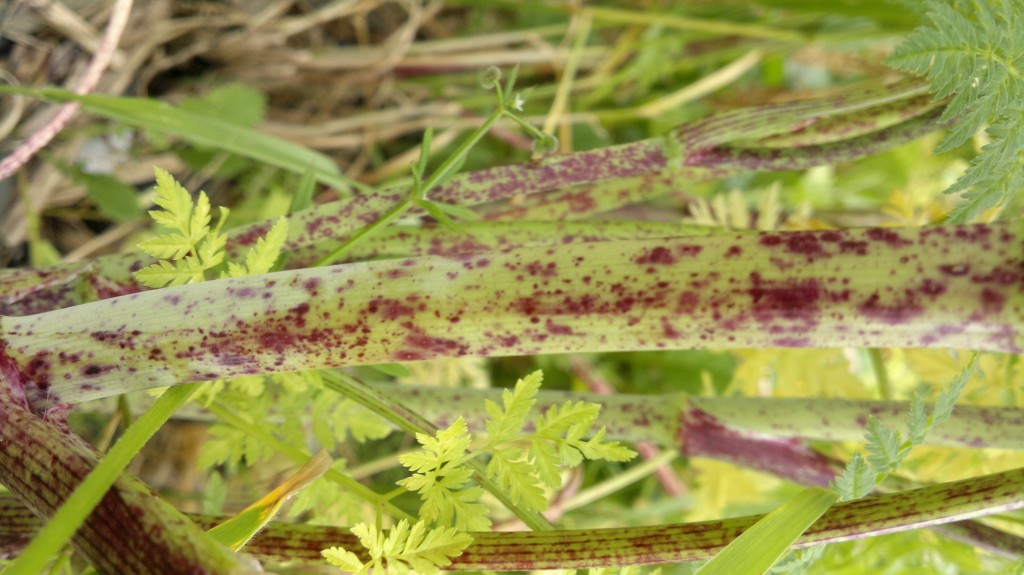
Hemlock stem
Coniine is the main active toxin which attacks the central nervous system, leading to paralysis and subsequent asphyxiation. 8 – 10 leaves could send you to your maker, though there is much variation according to season, stage of growth, location etc. The toxins are more concentrated in the roots and seeds.
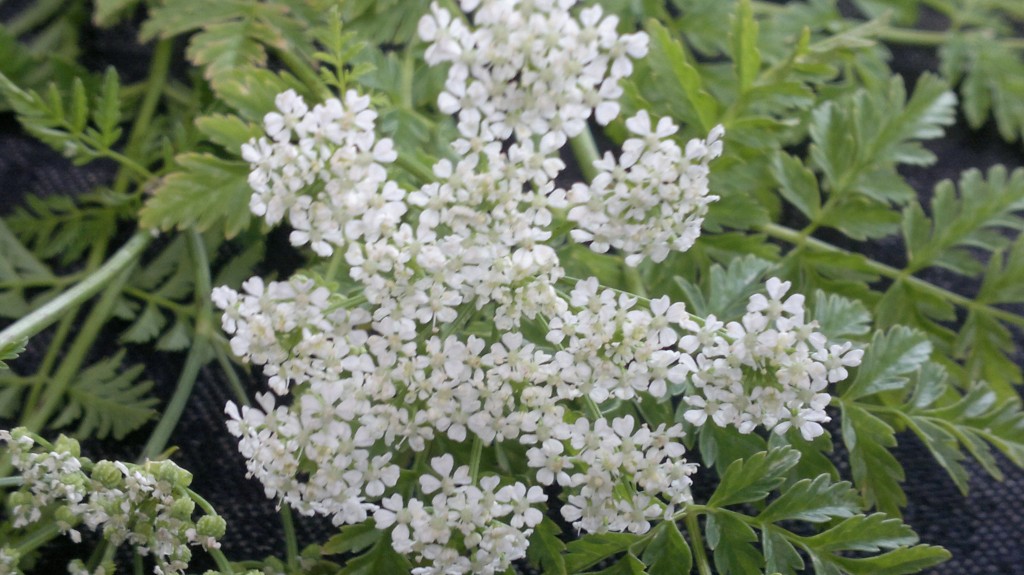
Hemlock flower
For more information on this and other members of the carrot family see “Know Your Carrots” and my in depth article – “An Introduction to the Apiaceae Family for Foragers”
For more discussion on toxic plants and fungi see “The Day I Ate a Deadly Plant: The Spectrum of Edibility”
10 Comments
Been doing your “Master Umbellifers in 2 Years” project and spotted hemlock this morning in Edinburgh. Never knowingly seen it before. Thoroughly delighted. I’ve been searching for it for years. Cheers, Mark!
Great, so glad its helping. weird how it feels better to find a really poisonous plant than a really tasty one! 🙂
Distribution seems to vary wildly for hemlock. Amazed to read that Joe above looked for years before finding it. I went for a walk in Bedfordshire this weekend and found it everywhere I looked. One footpath had non stop hemlock lining it for 2km or more.
Think I have some in the garden. Live on East Yorkshire coast. Is it OK as ornamental plant?
Yes…it doesn’t attack! Lots of ornamental plants are toxic.
I live in Central Illinois. Have about six to 10 plants in my yard behind the garage. But I don’t see any red spots or coloring no white flowers either
I live in the SW Ozarks in Missouri and just found out I have a bunch this growing on our 5 acres. So I’ve been pulling the big ones that have flowers and I’ll start mowing and bagging up the smaller ones next.
I’m not sure why you think this is necessary? They aren’t jumping down anyone’s throat, and lots of other creatures will appreciate them. Ignorance is dangerous, not plants! 🙂 Mark.
First I want to thank you for creating such an amazing resource—I’ve thoroughly enjoyed learning from your expertise! I wanted to add something here which I believe is important for anyone wading into the carrot family waters with regards to identification—young hemlock plants DO NOT always have the characteristic purple splotches on the stems. While those can be great ways to identify hemlock, the lack of them is not sufficient in identifying young specimens. Following is my personal story for anyone interested or who may be dealing with a similar situation.
I’ve unfortunately become far too close with hemlock over the past few months I moved to a small town in the Sierra de Gredos in Spain in February and in April I bought a few vegetables from a local shop, one of which was supposed to be parsley. A few days later I cooked dinner and distractedly chopped a bit of the herb to garnish. Within 15 minutes of eating I started feeling exceptionally drugged and dizzy with tingling in my extremities and it was so odd that I immediately went to the local clinic, where they sent me in ambulance to the hospital with suspected poisoning. I continued having intense hot flashes but the doctors had no idea what it was and eventually sent me home the following morning. Two days later I again cooked dinner and again added some of the herb. Again, within 15-20 minutes I developed the same symptoms but with much greater intensity. I immediately realized that the only thing I’d eaten both nights was the herb and luckily there were still 3 sprigs left for me to compare. One was clearly unlike the others and I knew at that point that what I’d eaten was, in fact, hemlock. I was again sent to the hospital emergency room and that night was unlike anything I’ve ever experienced. It was a terrifyingly psychedelic experience which culminated in my losing control of my legs up to my waist as my muscles fired uncontrollably for hours, amongst many other symptoms such as nearly blacking out, severe chest tightness, shallow breathing, etc. There is no antidote to hemlock poisoning and so all they were able to do was keep me in observation as we hoped that I hadn’t ingested a lethal dose. Eventually the symptoms eased and I was sent home but over the next two weeks I would daily experience intense waves of the poison working its way through my body, which I can only describe as like having the worst physical symptoms of a panic attack with chest tightness, shallow breathing, and an unmistakable dread. There have still been no doctors here in Spain (including the various neurologists I’ve seen) who have ever had any experience with hemlock poisoning and so I’ve basically been alone throughout the recovery. The extreme muscle and general fatigue persisted for almost two months but at this point I feel fully recovered and I’m very grateful to have survived the ordeal.
Ironically, it was my lack of certainty in being able to identify parsley in the wild that led to me buying the herb from the shop. The hemlock sprigs were mixed into the actual parsley and I never paid close attention when preparing them. This was obviously an extremely rare occurrence but it is yet another reason why it’s important to learn about these plants and to be very careful when identifying them. My apologies for the long comment but I thought it could be important to share. Thanks again for sharing your knowledge and wisdom here—it’s an invaluable resource!
Blimey, what a scary story! I’m glad you made it through – thanks for sharing.
Mark